Buying Custom soccer uniforms online is no longer limited to comparing colors and logos. Teams now expect durable fabrics, accurate sizing, clear delivery dates, and dependable customer service. Grand View Research estimated the global sports apparel market at approximately $249.9 billion in 2023. Its report also projects continued growth through 2030. This expansion gives buyers more choices, but it also creates more room for confusing specifications and disappointing quality.
A professional order should begin with evidence, not attractive product photos. The International Football Association Board’s Laws of the Game, including Law 4, defines essential player-equipment requirements. Clubs should check whether shirts, shorts, socks, numbers, and goalkeeper colors support match-day compliance. Material details matter too. A lightweight jersey should still withstand repeated washing, sliding, and outdoor use. DHL’s 2024 E-Commerce Trends Report highlights delivery reliability and return policies as important online purchasing factors. Those details deserve attention before payment.
Small mistakes become expensive.
The following seven tips examine supplier credibility, fabric performance, measurement charts, artwork approval, minimum quantities, delivery planning, and after-sales support. These areas reflect practical ordering experience, not only marketing claims. Still, no checklist removes every risk. Color may appear different on a phone screen, and one player may fall between two sizes. Buyers should request samples, confirm measurements, and keep written records of every approved detail. A cheaper quote can look attractive initially, yet replacement costs may change the final value. Careful comparison makes the order more predictable, even when online buying remains imperfect.
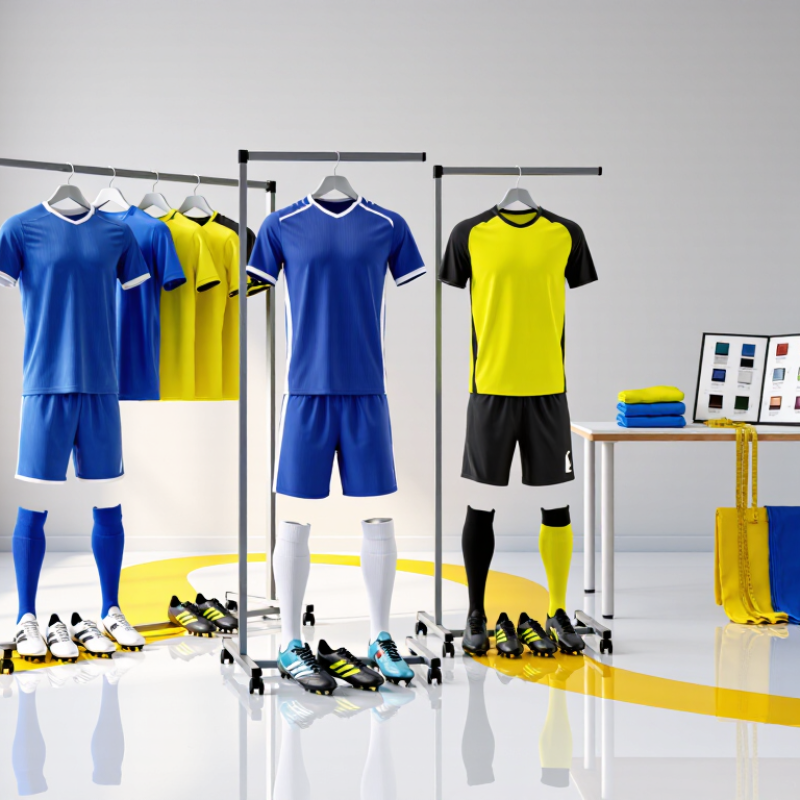
When buying custom soccer uniforms online, define match requirements before choosing colors or fonts. IFAB Law 4 identifies the basic kit: shirt with sleeves, shorts, socks, shinguards, and footwear. For the shirt, confirm sleeve coverage and clear separation from opponents and officials. Ask for a digital proof showing the front, back, numbers, and goalkeeper contrast.
Shorts should be practical, secure, and visually consistent with the team kit. Socks must cover the shinguards completely, without loose folds that expose them during play. Do not assume a fashionable design will pass inspection. Competition rules may add requirements for sponsor placement, numbering, or undershirt colors. Check the tournament handbook, not only the seller’s product page.
I once treated socks as a minor detail and nearly ordered a shade matching the opponent’s kit. That was careless. Measure players in playing clothes, compare the size chart, and order one sample if timing allows. Ask about fabric weight, washing, delivery dates, and replacement pieces. Keep written approval from the competition organizer when colors are close. Small mistakes become obvious on match day. A careful checklist is worth more than a rushed discount.
When buying custom soccer uniforms online, compare fabric weight before judging color or trim. Ask for the mass per unit area in g/m², not vague terms like “premium” or “lightweight.” ASTM D3776/D3776M measures fabric mass per unit area through recognized weighing procedures. Request the test method, conditioning details, and sample size from the supplier. A jersey listed at 145 g/m² may feel very different from one tested after moisture exposure.
Fabric weight affects comfort, durability, and heat management. Lower-weight fabric can feel cooler during a humid match, but it may appear more transparent under stadium lights. Heavier fabric can resist repeated washing better, yet it may hold more heat during long training sessions. I have seen online samples feel soft, then become clingy after sweat. Small details matter. Check the knit structure and seam density, too.
Pair ASTM data with AATCC TM195 moisture-management results. This test reports wetting time, absorption rate, spreading speed, and one-way transport behavior. Do not accept “quick-dry” as sufficient evidence. Ask for the actual report, testing date, fabric composition, and results after laundering. A fabric with strong spreading performance may still dry slowly in a crowded locker room. That is an easy detail to miss. Compare matched samples, because colorants, mesh panels, and finishing treatments can change performance. Cost matters, but reliable test data matters more.
Compare fabric weight in g/m² using ASTM D3776 and moisture-management performance using AATCC 195 before selecting an online uniform supplier.
The chart compares common soccer-uniform fabric constructions. Fabric weight is measured in grams per square metre (g/m²) under ASTM D3776, while the AATCC 195 Overall Moisture Management Capacity (OMMC) score indicates how effectively a fabric manages perspiration; higher values generally indicate better moisture transfer. When buying online, ask for a recent laboratory test report, confirm fabric composition, check size charts, request a pre-production sample, and verify colorfastness and care instructions.
When buying custom soccer uniforms online, start with measurements, not the size labels. Build your chart from ISO 8559-1 body measures, including chest, waist, hip, shoulder, and back length. Measure players in light clothing with a flexible tape. Keep the tape level, but do not pull it tight. My first chart looked precise, yet I missed the difference between a relaxed waist and a match-ready fit. That mistake created avoidable exchanges.
Request the supplier’s garment measurements, not only body measurements. Compare a sample jersey against your chart at the chest, sleeve opening, and hem. Leave enough room for movement and base layers. A goalkeeper’s fit may need extra shoulder space. Youth players also change quickly. Record each measurement with the date, because team rosters rarely stay still. Small details matter here.
Fabric care deserves equal attention. Test two or three percent shrinkage before approving the full order. Wash one sample using the planned temperature and drying method. Measure it before and after, especially across the chest and body length. A 2% reduction can change a comfortable jersey into a tight one. Do not assume every fabric behaves identically. I once treated the percentage as universal, and that was a poor shortcut. Ask for the fabric composition, washing instructions, and production tolerances in writing. Then check the final digital proof against the approved chart.
7 Tips for Buying Custom Soccer Uniforms Online
Custom soccer kits often look different on a screen. Color settings, lighting, and fabric texture can mislead buyers. Grand View Research estimated the global sports apparel market at over US$200 billion in 2023, increasing pressure on suppliers to deliver consistent colors and durable garments. Ask for a physical fabric swatch before ordering. It may feel old-fashioned, but it prevents expensive surprises.
Tip 1: Approve colors with Pantone codes, not screen images. Include the exact code, fabric type, and printing method in the approval record. A Pantone shade on polyester can appear slightly different from the same shade on cotton. Request a lab dip or pre-production sample under daylight. Tip 2: Require an AATCC 16 lightfastness test report. This method evaluates color resistance under controlled light exposure, often using xenon-arc equipment. It does not automatically define a passing score, so agree on the target grade with the supplier before production. For outdoor teams, ask how many exposure hours the report represents.
Tip 3: Test the actual finished fabric, not only loose dye. Tip 4: Check sponsor graphics after washing and drying. The American Association of Textile Chemists and Colorists emphasizes controlled test conditions, because temperature, humidity, and exposure settings affect results. A report without those details is incomplete. I have seen teams approve a strong navy that became visibly dull beside older jerseys. That mistake was avoidable, though no approval process is perfect. Keep one signed sample for future reorders.
| No. | Buying Tip | What to Check | Recommended Data or Standard | Approval Evidence | Why It Matters |
|---|---|---|---|---|---|
| 1 | Confirm the exact color reference | Specify the intended solid color for the body fabric, collar, cuffs, numbers, names, and decorative panels. | Use a Pantone Textile or Fashion reference where applicable; record the complete code and finish, such as coated, uncoated, or textile format. | Request a digital artwork proof plus a physical fabric or printed color swatch before bulk production. | Screen colors can vary by monitor, fabric type, dye process, and surface finish. |
| 2 | Approve a physical pre-production sample | Compare the actual polyester fabric, trim, heat-transfer film, embroidery thread, and printed graphics under neutral lighting. | Evaluate under approximately 5,000 K to 6,500 K daylight-simulating light and avoid judging color under colored indoor lighting. | Keep one approved, dated, and signed sample as the production reference. | A color code defines a target, but the final appearance can change on different materials. |
| 3 | Ask for lightfastness test information | Check whether the fabric dye and printed graphics were tested for resistance to fading caused by light exposure. | Request testing to AATCC 16, using the applicable xenon-arc or other specified light-exposure procedure, with the method version identified. | Obtain a laboratory report showing the test method, material tested, exposure conditions, and rating or evaluation result. | Outdoor matches and training sessions can expose uniforms to strong sunlight over time. |
| 4 | Set a measurable fading requirement | Define the minimum acceptable performance for the primary fabric and high-visibility graphics before placing the order. | Use a documented pass/fail threshold agreed in writing; for gray-scale assessments, a higher grade indicates less perceptible change. | Require the report to identify whether the result applies to the fabric, print, transfer, or embroidery rather than assuming one result covers all components. | Different materials and decoration methods may fade at different rates. |
| 5 | Verify fabric composition and construction | Review fiber content, fabric weight, stretch, breathability, and moisture-management claims. | Confirm the stated composition, commonly 100% polyester or a polyester blend, together with fabric weight in g/m² and the knit or weave type. | Request a technical specification sheet and compare it with the sample garment. | Fabric structure affects color appearance, comfort, durability, and how decoration adheres. |
| 6 | Check sizing with garment measurements | Compare the supplier’s size chart with player chest, waist, hip, inseam, and preferred fit measurements. | Use garment measurements in centimetres or inches; allow room for movement and confirm whether measurements are body or finished-garment dimensions. | Order a representative sample size or fitting set before finalizing the team quantity. | Size labels are not standardized across suppliers, and a wrong fit can make a uniform unusable. |
| 7 | Confirm production, inspection, and delivery terms | Review artwork approval deadlines, sample approval, minimum order quantity, production time, shipping time, and replacement policy. | Obtain a written schedule with separate production and transit estimates, plus a pre-shipment inspection or measurement checklist. | Approve the final order record containing colors, sizes, quantities, player names, numbers, decoration positions, and packaging instructions. | Clear records reduce color, personalization, quantity, and deadline disputes. |
Buying custom soccer uniforms online is safer when delivery promises become written evidence. The Baymard Institute’s 2024 benchmark places average cart abandonment at 70.19%, often linked to unclear costs and delivery details. Ask for a written service-level agreement (SLA) before paying. It should state artwork approval dates, production time, shipping method, tracking, delay notices, and remedies. Avoid vague phrases like “fast delivery.” Request a firm arrival window.
Check every FTC-required textile label detail that applies, including fiber content, country of origin, and responsible business identification. Labels must match the actual garment. A wrong fiber statement can create avoidable compliance and trust problems. Confirm the label’s wording and placement in writing. Then request a physical or digital sample. Inspect fabric weight, stitching, color under indoor light, player numbers, names, badges, and sponsor positions. Keep the approved file and sample version.
Use a sign-off sheet with measurements for every player. Include tolerance limits, such as a one-centimeter print shift. It sounds fussy, but it prevents arguments. Ask whether replacement uniforms follow the same approved specification. DHL’s 2024 e-commerce report indicates that delivery options strongly influence online purchase decisions, so confirm split shipments and customs responsibilities. My own practical caution is simple: I once treated an email approval as enough. It was not. A dated, signed sample approval is stronger than a confident phone call. Allow extra time for one correction. Perfect schedules rarely survive real production.
It should include a sleeved shirt, shorts, socks, shinguards, and suitable footwear. Check the competition handbook too.
Compare the full kit with opponents and officials’ colors. Check shirts, shorts, socks, and goalkeeper contrast. Keep written approval.
Request the front, back, player numbers, sleeve coverage, and goalkeeper colors. Review sponsor and undershirt rules when applicable.
Fabric weight affects comfort, durability, heat, and possible transparency under stadium lights. Ask for weight in g/m². “Premium” proves little.
Request wetting time, absorption, spreading speed, and one-way transport results. Ask for fabric composition and laundering results.
Measure chest, waist, hips, shoulders, and back length with a flexible tape. Measure players in light clothing. Do not pull tightly.
Garment measurements reveal the actual chest, sleeve opening, and hem dimensions. They also show whether base layers will fit comfortably.
Wash two or three samples using the planned temperature and drying method. Measure chest and body length before and afterward.
Confirm fabric weight, washing instructions, delivery dates, replacement pieces, and production tolerances in writing. Order one sample when possible. Rushed savings can backfire.
Buying Custom soccer uniforms online is easier when every requirement is defined before placing an order. Start by checking match rules, especially the shirt, shorts, and sock specifications outlined in FIFA Law 4. Compare fabric options by weight in g/m², and ask for performance information such as moisture-wicking results measured with ASTM D3776 and AATCC 195 methods. A clear size chart should be built from consistent ISO 8559-1 body measurements, while wash testing can confirm whether the garments remain within an acceptable 2–3% shrinkage range.
Color accuracy and delivery protection are equally important. Approve team colors with precise Pantone codes and request lightfastness testing based on AATCC 16 to reduce fading concerns. Before production, confirm required FTC labeling details, document delivery schedules and quality expectations in a written service-level agreement, and approve a physical or digital sample. These steps help prevent sizing, color, quality, and timing problems.